
Payglocal vs xPay | Best Payglocal alternative

For Indian Enterprises, SaaS companies, digital exporters, and subscription businesses, international payments are not a backend utility. They directly determine approval rates, realized revenue, FX leakage, finance workload, and ultimately growth velocity.
Two platforms commonly evaluated in this space are PayGlocal and xPay.
Both enable cross-border acceptance.
Both are built for Indian exporters.
But when evaluated across success rates, pricing, checkout coverage, FX transparency, and compliance automation — meaningful differences emerge.
This analysis focuses on the metrics that matter most to scaling businesses.
1. Success Rates: Revenue You Either Capture or Lose
Approval rate is the most underrated growth lever in international payments.
A difference of 5–10 percentage points is not marginal. It is pure revenue uplift without additional marketing spend.
PayGlocal
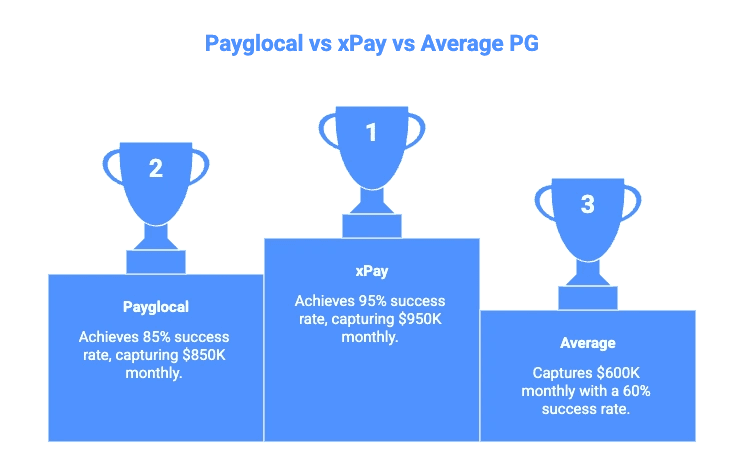
Average international success rate: ~80%
xPay
Average international success rate: ~95%
What does this mean in practice?
If you process $1M per month in international volume:
At 80% success → $800K captured
At 95% success → $950K captured
That is $150,000 additional monthly realized revenue
Or $1.8M annually — without increasing traffic.
For SaaS and subscription businesses, approval rate is often more impactful than pricing.
Why the difference?
xPay’s infrastructure combines:
Optimized routing
Local acquiring partnerships
Wallet + alternative method coverage
Reduced friction checkout flows
The result is materially higher authorization capture across key corridors.
Edge: xPay
2. Pricing: Effective Cost Per Dollar Processed
While success rates drive topline capture, pricing determines retained margin.
PayGlocal
Effective pricing: ~3.75% for international processing
xPay
Effective pricing: ~3.0% for international processing
At first glance, the delta seems small.
But at scale, it compounds.
On $1M monthly volume:
PayGlocal at 3.75% → $37,500 in fees
xPay at 3.0% → $30,000 in fees
That is $7,500 saved monthly
Or $90,000 annually
Now combine:
Higher success rate + Lower fee = double impact
When you model both together:
Metric | PayGlocal | xPay |
|---|---|---|
Monthly Attempted Volume | $1,000,000 | $1,000,000 |
Approval Rate | 80% | 95% |
Captured Revenue | $800,000 | $950,000 |
Processing Fee | 3.75% | 3.0% |
Net After Fees | $778,125 | $921,500 |
That is a $143,375 monthly difference in net revenue
Or over $1.8M annually.
Even if your volume is smaller, the margin uplift remains structurally meaningful.
Edge: xPay
3. Payment Method Coverage & Checkout
PayGlocal provides:
International card acceptance
20 Global payment methods
Recurring billing
Multi-currency support
xPay provides:
International cards
45+ global and local payment methods like Apple Pay, wallets, BNPL options and CC EMI
Multi-currency pricing
Brand-able checkout
Subscription-ready infrastructure
Virtual bank accounts
For SaaS businesses selling in the US, EU, and emerging markets, payment method diversity often correlates with approval lift.
xPay integrates bank transfers, wallets, cards, and subscriptions into one unified stack.
Edge: xPay (broader infrastructure)
4. Virtual Accounts & Bank Transfers
Both platforms support multi-currency account collections.
xPay additionally offers:
Virtual USD, GBP, EUR accounts
1% pricing on bank transfer collections
Zero FX markup
Automated FIRC
Export-ready documentation
For businesses with mixed B2B + self-serve flows, having both bank transfer rails and global checkout under one integration simplifies operations.
Edge: xPay
5. FX Transparency & Revenue Predictability
International businesses often underestimate FX leakage.
xPay provides:
Live mid-market FX
Zero hidden markup
Real-time visibility on dashboard
Transparent FX improves forecasting and protects margin.
Edge: xPay
6. Compliance & Finance Ops
PayGlocal:
Provides FIRA/FIRC post settlement
RBI-regulated infrastructure
PA-BC Compliant
xPay:
Instant automated FIRC
Purpose code tagging
GST/LUT-ready documentation
Streamlined export workflows
PCI-DSS Compliant
Settlement via PA-CB channels
For finance teams handling zero-rated GST and monthly filings, automation reduces internal operational cost.
Edge: xPay
Where PayGlocal Still Makes Sense
PayGlocal may be appropriate if:
Your approval rates are already strong
Your business model is primarily straightforward card acceptance
You are earlier in international scale
It is a credible cross-border platform.
Where xPay Becomes the Stronger Strategic Choice
xPay becomes compelling when:
You are scaling on high volumes or subscription revenue
Approval rates directly affect ARR
You want both virtual accounts and global checkout
You want lower effective processing cost
You care about FX transparency
You want automated export compliance
You are optimizing net revenue, not just gateway cost
Final Verdict
Both PayGlocal and xPay are capable cross-border payment platforms.
xPay consistently delivers stronger revenue outcomes for high-growth exporters.
For companies processing meaningful international GMV, the difference is not incremental.
It is structural.
FAQ's
What is PayGlocal and how does it help Indian businesses accept international payments?
PayGlocal is a cross-border payments platform that enables Indian merchants to accept international payments through global payment methods (cards, wallets) and multi-currency collections. It supports international checkout, recurring billing, and multi-currency accounts, and is RBI-authorised to operate cross-border payment aggregation services.
How does PayGlocal’s international payment pricing work?
PayGlocal publicly lists standard pricing for international acceptance at around 3.75% for card transactions and 0.25% for multi-currency account collections, with options for customized pricing depending on volume and product mix.
What payment methods and checkout options does PayGlocal support?
PayGlocal supports major global debit and credit cards and 20+ international payment methods such as Trustly, Sofort, Grabpay and Klarna. Merchants can accept payments via hosted checkout, payment links, buttons, and automated recurring billing.
What is the role of multi-currency accounts in PayGlocal?
PayGlocal’s multi-currency accounts allow businesses to receive funds in multiple global currencies, providing faster and more efficient settlement than traditional banks. Merchants can collect in 33+ currencies from customers in 180+ countries.
How does PayGlocal ensure secure and compliant cross-border transactions?
PayGlocal operates under RBI’s Payment Aggregator – Cross Border – Inward & Outward (PA-CB-I&O) authorisation, enabling compliant international payment flows. It also uses encryption, fraud prevention, and secure checkout practices to protect customer data and reduce payment risk.
What is the difference between xPay and PayGlocal for international payment acceptance?
Both xPay and PayGlocal enable Indian businesses to collect cross-border payments, but they differ in core capabilities. PayGlocal focuses on international card processing and multi-currency account collections with flat pricing and RBI-regulated compliance. xPay offers all of that plus broader payment method coverage (45+ methods), virtual bank accounts, subscription billing, higher approval rates (~95% vs ~85%), and integrated export compliance automation — offering both global checkout and bank transfer rails from one platform.
Which platform has better international success rates: xPay or PayGlocal?
International approval rates directly impact realized revenue for exporters and SaaS companies. In comparative usage patterns, PayGlocal’s average international success rate is ~85%, whereas xPay’s routing logic, local acquiring partnerships, and broader method coverage support ~95% success rates. Even a 5–10% improvement in approval can translate into significant incremental revenue without increasing traffic or CAC.
How do xPay and PayGlocal compare on pricing and cost for international payments?
Pricing differences matter for net revenue, especially at scale. PayGlocal’s standard international card processing fee is around 3.75%, while xPay’s effective pricing for similar flows is approximately 3.0%. On $1M in monthly international volume, this fee delta alone can save tens of thousands of dollars annually. Combined with higher success rates and improved FX transparency, xPay’s model often results in better retained margin for fast-scaling exporters.