
How Cross-Border Payments Work in India (2026 Guide)

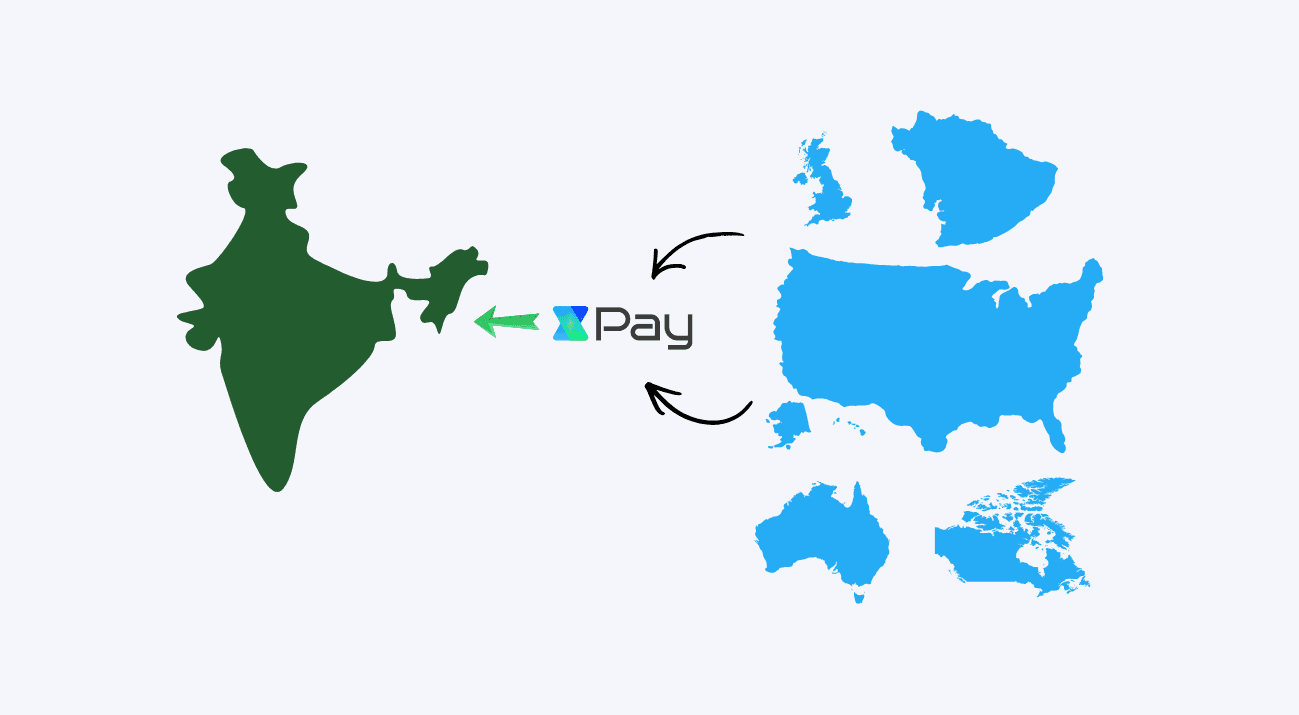
If you are an Indian business selling globally, understanding how cross-border payments work is mission-critical. Cross-border payments are more complex than domestic ones because they span multiple banks, regulations, currencies, risk engines, and settlement systems. Mistakes or misunderstandings at any step can lead to declines, regulatory issues, or revenue leakage.
This guide explains:
What cross-border payments are
How they actually flow when you receive money in India
Key actors and regulations in India
Common failure points and hidden costs
How xPay’s infrastructure improves success, compliance, and predictability
By the end, you’ll understand the full lifecycle of a cross-border payment in India — from your customer’s card swipe to INR in your bank account.
1) What are cross-border payments?
A cross-border payment is any transaction where the customer’s bank, card network, or payment processor is outside the merchant’s country.
For Indian merchants this means:
The card is issued outside India
The issuer is outside India
The currency is not INR
The settlement involves foreign exchange and regulatory clearing
Cross-border does not just mean geography. It means multiple legal and operational systems interacting in real time.
2) How cross-border payments work: step-by-step
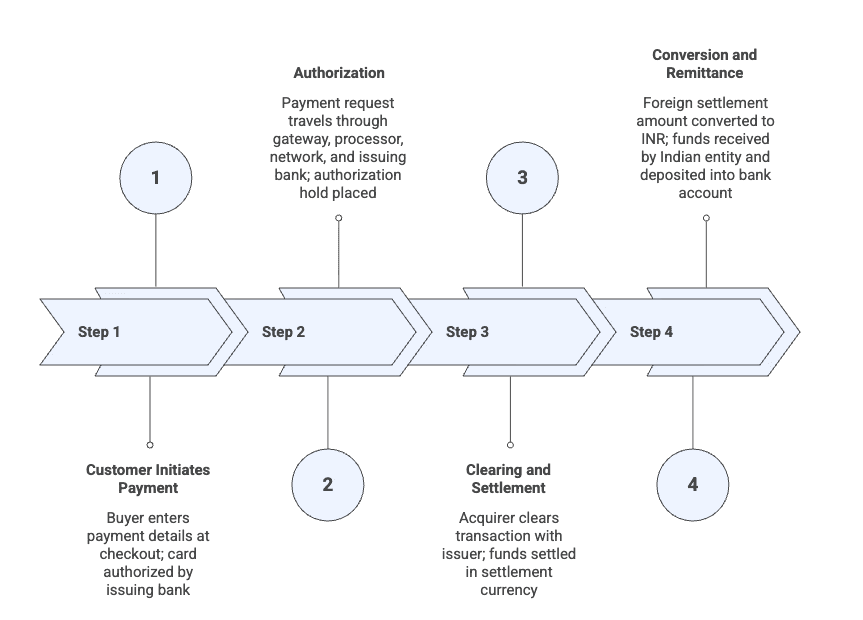
At a high level, here is the flow from a customer purchase to settlement in India:
Step 1: Customer initiates payment
A buyer enters payment details in your checkout, typically a:
Card (Visa, Mastercard, Amex, JCB, UnionPay, etc)
Wallet or alternate payment method supported globally
The card is authorized through the customer’s issuing bank outside India.
Step 2: Authorization
The payment request travels through:
The merchant’s payment gateway
A processor or acquirer
Card network (Visa / Mastercard / Amex)
Issuing bank
The issuer decides whether to approve or decline.
If approved, an authorization hold is placed.
Step 3: Clearing and settlement
Once authorized, the transaction enters clearing and settlement:
The acquirer (or its processing partner) clears the transaction with the issuer through the network.
Funds are settled from the issuer’s bank to the acquirer’s account in settlement currency (often USD or EUR).
FX conversion is required to bring that money into INR.
Step 4: Conversion and remittance to India
This is where the international leg ends and India’s regulatory rails begin:
The foreign settlement amount is converted to INR.
The funds are received by an Indian entity either directly or via a collection agent model.
Compliant documentation (purpose codes, KYC, tax forms) is attached.
The INR is deposited into your Indian bank account.
This final leg is governed by FEMA, RBI rules, and banking regulations.
3) Regulatory and compliance requirements in India
Cross-border payments into India must satisfy several compliance points, including:
a) FEMA compliance
The Foreign Exchange Management Act (FEMA) regulates inflows and outflows of foreign exchange. Incoming foreign funds must:
Be reported to the RBI
Have correct purpose codes
Match KYC and documentation requirements
b) Purpose codes
These codes determine the nature of the transaction (e.g., sale of goods, services, SaaS export). Incorrect or missing codes cause:
Regulatory holds
Payment delays
Blocked settlements
c) KYC and documentation
Banks require:
Merchant identity proof
Export documentation
Contract or agreement details
GST and PAN details
These are necessary for foreign inflows to be credited and taxed appropriately.
d) FIRC issuance
A Foreign Inward Remittance Certificate (FIRC) is proof of foreign payment receipt. FIRCs are needed for:
GST compliance
Corporate filings
Accounting and audit
Instant, GST-compliant FIRCs remove reconciliation delays and reduce compliance risk.
4) Common challenges Indian merchants face
Indian merchants selling abroad often struggle with:
Declines due to compliance data gaps
Missing purpose codes or IEC can trigger declines or settlement rejects.
FX leakage and poor routing
Unoptimized FX and routing layers eat into margin.
Issuer and network declines
Issuers block transactions due to high risk perception on cross-border buys.
Latency and UX friction
Authentication failures or latency kill conversions.
Manual reconciliation
Late FIRCs and settlement mismatches create accounting headaches.
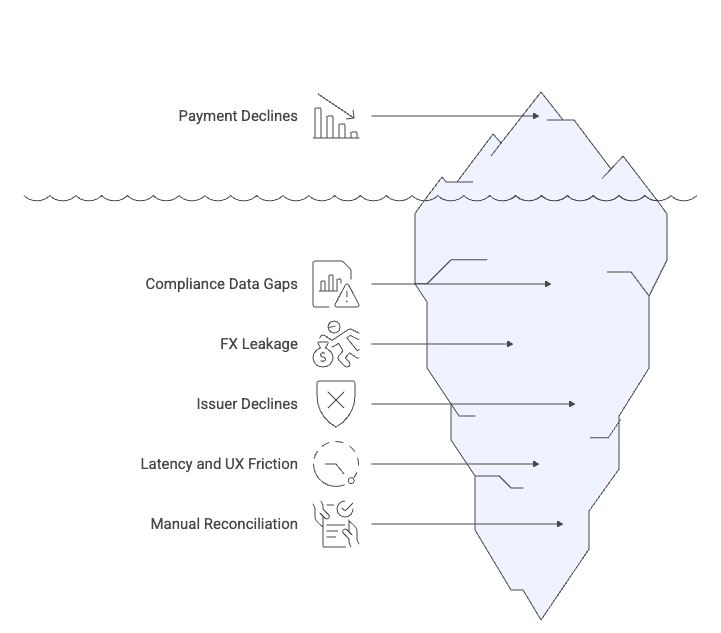
Understanding why these happen is the first step toward solving them.
5) Improving cross-border payment success rates
Top global merchants optimize success with:
a) Complete compliance metadata
Purpose codes, export docs, and correct KYC data attached to every transaction.
b) Local currency display
Customers convert less often and drop declines.
c) Smart routing
Dynamic routing through multiple acquiring partners reduces declines and improves success rates.
d) Strong customer authentication
Careful 3DS design with fallback logic.
e) Data driven decline handling
Track declines by code, geography, issuer, and method.
If you apply these steps consistently, success rates rise organically.
6) How xPay’s cross-border flow works
xPay’s cross-border payment infrastructure was built specifically for Indian merchants selling globally. It solves every step of the international flow with compliance, routing intelligence, and risk-aware optimization.
1) Local acquiring and collection agent model
Rather than processing everything as a fully foreign transaction, xPay operates as a local Collection Agent:
Payments from international cards are processed via licensed local processors and banks in the customer’s geography.
Funds settle into a local collection account rather than a remote corporate account.
To the issuer and network, the transaction appears local or near-local — not a risky cross-border charge.
This significantly boosts approval and authorization success.
2) Compliance-first settlement into India
After collection, funds move into India through:
Regulated AD1 banking channels
PA-CB providers
This ensures every settlement:
Meets FEMA and RBI compliance
Is supported with correct purpose codes
Has KYC and export documentation attached
xPay also ensures GST-compliant FIRCs are issued instantly by partner banks or providers, removing reconciliation delays.
3) Legal clarity at every step
xPay’s transaction and fund-flow architecture is supported by formal legal opinions in both India and the United States. This reduces risk of:
Regulatory intervention
Settlement holds
Compliance rejections
Merchants benefit from predictability and scaleibility.
4) Intelligent routing and retry logic
xPay’s technology:
Sends transactions through optimal pathways for approval
Retries declines intelligently with alternative routes
Uses data to improve routing over time
This reduces false declines and increases success rates without manual ops work.
5) Dashboard and operational insights
xPay gives merchants:
Success rates by country, currency, and method
Decline taxonomy and trends
Settlement visibility and reconciliation support
This turns payments from a technical black-box into a growth lever.
7) A 30-day operational checklist
Compliance
Ensure purpose code setup is correct
Attach IEC and export docs to payment metadata
Checkout
Display local currency prices
Implement 3DS with fallback
Routing
Enable smart acquiring paths
Test retries on common decline codes
Reconciliation
Confirm FIRC issuance setup
Sync bank settlements to xPay dashboard
Risk
Monitor issuer decline trends
Tune fraud rules based on data
8) FAQs
What is a cross-border payment?
A payment where the card, issuer, or bank is outside the merchant’s country.
Do I need purpose codes for every transaction?
Yes. Incorrect codes are a leading cause of declines and settlement blocks.
Can international success rates be improved?
Absolutely. Routing, compliance metadata, authentication, and local acquiring all matter.
What is a FIRC?
A Foreign Inward Remittance Certificate, required proof of foreign funds received into India.
Closing thoughts
Cross-border payments are a core part of global commerce, but they are also complex because they bridge payments, compliance, and banking systems.
For Indian merchants, success requires more than just a gateway token. It requires:
Correct compliance metadata
Smart routing logic
Local acquiring
Regulatory alignment
Real-time visibility
This is how payments stop being a cost drag and become a growth engine.
If your current cross-border setup treats international acceptance as an afterthought, your revenue is leaking silently. Redesign the flow, not just the checkout.