
How can Exporters Receive Payments from Global Buyers

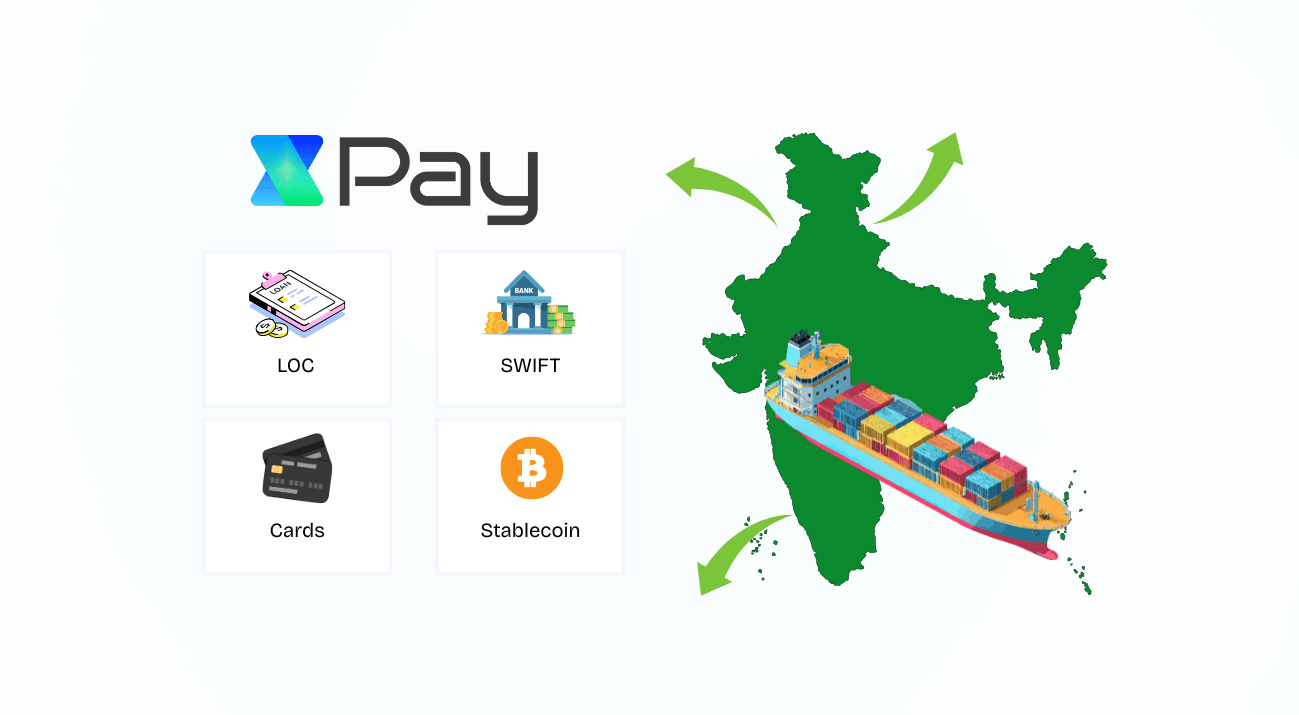
Global demand for Indian products and services has never been stronger. India’s exports crossed $825 billion in 2024-25, reflecting the growing number of Indian companies selling globally.
From SaaS companies and digital services to travel platforms, e-commerce brands, and traditional exporters, businesses across India now work with buyers from the US, Europe, the Middle East, and Asia.
But one question remains fundamental:
How do exporters actually receive payments from international buyers?
Cross-border payments involve foreign currencies, compliance requirements, banking networks, and payment infrastructure that can feel complex.
This guide explains:
The main ways exporters receive international payments
The process of getting paid from global buyers
The regulatory and compliance requirements
And how modern infrastructure platforms like xPay simplify the entire process.
The Basics: What Is an Export Payment?
An export payment occurs when a foreign buyer pays an Indian business for goods or services.
These payments usually involve:
Foreign currency transactions
Cross-border banking networks
Currency conversion
Regulatory compliance
Unlike domestic payments, international transactions often pass through multiple intermediaries such as banks, card networks, and payment processors before reaching the exporter’s account.
This complexity affects costs, settlement time, and success rates.
Common Ways Exporters Receive Payments
There are several payment methods used in global trade. Each method balances risk, speed, and convenience for both buyer and seller.
The most widely used export payment methods include:
Bank wire transfers
Letters of credit
Documentary collections
Open account payments
Card payments and digital wallets
Cross-border payment gateways
These payment structures have evolved over decades of global trade.
Let’s break them down.
1. International Bank Transfers (SWIFT / Wire Transfers)
One of the oldest and most common export payment methods is a bank wire transfer through the SWIFT network.
In this setup:
The buyer initiates a transfer from their bank.
The funds move through international banking networks.
The exporter receives the funds in their bank account.
Bank transfers are commonly used for large transactions or B2B trade payments.
Wire transfers and credit card payments are among the most common “cash-in-advance” payment options used by exporters.
Pros
Trusted global system
Suitable for large invoice payments
Widely accepted in international trade
Cons
Settlement can take 3–5 days or longer
Multiple intermediary bank fees
Manual reconciliation
Limited payment flexibility for buyers
2. Letters of Credit (LC)
A Letter of Credit (LC) is a payment guarantee issued by a bank.
Here’s how it works:
The buyer’s bank guarantees payment to the exporter.
The exporter ships the goods.
The exporter submits documents to the bank.
The bank releases payment after verifying documents.
Letters of credit are one of the most secure methods in international trade because the bank guarantees payment once contractual conditions are met.
Pros
Strong payment protection
Reduced credit risk
Cons
Expensive bank fees
Heavy documentation
Slow processing
For modern digital exports such as SaaS or online services, LCs are rarely used today.
3. Documentary Collection
Documentary collection is a bank-mediated payment process where shipping documents are released to the buyer only after payment or acceptance of payment terms.
Banks act as intermediaries but do not guarantee payment, unlike letters of credit.
Pros
Cheaper than letters of credit
Provides some control over shipping documents
Cons
No payment guarantee
Slower processing
Complex documentation
4. Open Account Payments
In an open account arrangement:
The exporter ships goods.
The buyer pays later (often 30–90 days).
This method is common in long-term trade relationships.
However, it introduces credit risk for exporters because the buyer pays after delivery.
5. International Card Payments
For digital exports, SaaS companies, and online businesses, international cards have become one of the most popular payment methods.
Buyers can pay using:
Visa
Mastercard
American Express
This method allows instant checkout and faster payment flows compared to traditional trade finance methods.
However, card payments come with challenges:
Cross-border approval failures
Fraud risk
High payment processing fees
6. Digital Wallets and Local Payment Methods
Global customers increasingly prefer digital wallets and regional payment methods instead of cards.
Examples include:
Apple Pay
Klarna
Cash App
Bank transfers
Regional wallets
Offering local payment methods dramatically improves conversion rates for international checkouts.
The Compliance Side of Export Payments
Receiving payments from abroad involves regulatory documentation.
For Indian exporters, one key document is the Foreign Inward Remittance Certificate (FIRC).
An FIRC is issued by banks as proof that a business has received foreign currency from overseas.
This document is important for:
GST compliance
Export incentives
Accounting records
FEMA regulations
Traditionally, obtaining FIRCs involved manual requests with banks, which could take days or weeks.
Challenges Exporters Face While Receiving Global Payments
While selling internationally is easier than ever, collecting payments still presents challenges.
1. High Payment Costs
Exporters often pay multiple layers of fees:
Payment gateway fees
Foreign exchange margins
Bank charges
This can significantly reduce margins.
2. Payment Failures
International card transactions often fail due to:
Cross-border fraud checks
Bank authorization issues
Currency mismatches
Even small differences in approval rates can lead to significant revenue loss at scale.
3. Slow Settlements
Traditional payment methods like bank transfers may take several days to settle.
Delayed payments affect:
Cash flow
Working capital
Operational planning
4. Compliance Complexity
Exporters must also manage:
RBI purpose codes
FIRC documentation
Foreign exchange reporting
Handling these manually becomes difficult as payment volume grows.
Settlement to Exporters
While collecting international payments is one part of the journey, ensuring smooth FX conversion and compliant INR settlements is equally important for exporters.
At xPay, we work with a set of trusted infrastructure partners to streamline this layer. For FX and cross-border settlement flows, we’ve partnered with Xflow, which helps enable efficient fund movement, transparent conversion, and compliant payouts for Indian businesses.
This ensures exporters receive their funds reliably with the required documentation in place, without having to manage multiple fragmented systems.
The Modern Way Exporters Receive Payments
Today, many exporters use global payment infrastructure platforms that combine multiple payment rails into a single system.
These platforms allow exporters to:
Accept payments from 180+ countries
Offer multiple payment methods
Receive settlements in INR
Automate compliance documentation
Instead of managing multiple banks and integrations, exporters can operate through a single payment layer.
How Exporters Collect Payments Using xPay
xPay is built specifically for businesses selling globally from India.
Instead of relying on fragmented systems, exporters can use xPay to manage the entire cross-border payment stack.
Global Payment Acceptance
Exporters can accept payments using:
International cards
Apple Pay
Klarna
Cash App
Local payment rails
This helps businesses capture customers in multiple regions.
Higher Payment Success Rates
Cross-border payments often fail due to routing issues and bank declines.
xPay uses optimized payment infrastructure designed for international transactions, enabling success rates above 90% for global payments.
Higher approval rates directly increase revenue without additional marketing spend.
Instant FIRC Generation
For exporters, compliance documentation is critical.
xPay automatically generates instant FIRCs, simplifying:
GST compliance
Export reporting
Accounting workflows
Lower Effective Fees
Exporters often lose margin due to FX spreads and processing charges.
xPay optimizes currency conversion and payment routing to reduce the total effective cost of cross-border payments.
Fast Integration
Instead of integrating multiple payment systems, exporters can connect to xPay through a single API or checkout.
This allows businesses to start accepting international payments quickly.
Which Payment Method Is Best for Exporters?
The best method depends on the type of business.
Business Type | Preferred Payment Method |
|---|---|
Traditional goods exporters | Bank transfers or letters of credit |
SaaS companies | Card payments and payment gateways |
Digital services | Online checkout payments |
E-commerce exporters | Payment gateways with global wallets |
For modern exporters selling digitally across markets, global payment platforms provide the best combination of speed, reliability, and scalability.
Final Thoughts
Selling globally is no longer limited to large enterprises.
Today, Indian startups, SaaS companies, and exporters can reach customers in over 180 countries.
But receiving payments from international buyers still requires the right infrastructure.
Traditional payment methods like bank transfers and letters of credit remain important in trade, but modern businesses increasingly rely on global payment platforms that simplify:
payment acceptance
compliance
currency conversion
settlement
Platforms like xPay allow exporters to accept global payments, improve success rates, and reduce operational complexity.
For businesses scaling internationally, the ability to collect payments seamlessly from customers worldwide is no longer just a finance function.
It is a core growth engine.
Frequently Asked Questions (FAQs)
How do exporters receive payments from international buyers?
Exporters receive payments from global buyers through several methods including international bank transfers (SWIFT), letters of credit, documentary collections, card payments, and global payment gateways. Traditional exporters often use bank transfers, while digital businesses like SaaS or e-commerce companies use international payment gateways that allow customers to pay via cards, wallets, and local payment methods.
What is the most common way exporters get paid?
The most common payment method in international trade is bank wire transfers through the SWIFT network. Buyers transfer funds directly from their bank to the exporter’s bank account. However, modern exporters increasingly use global payment gateways that allow customers to pay instantly using cards, wallets, and regional payment methods.
What is the safest payment method in international trade?
The safest payment methods for exporters are letters of credit and cash in advance. Letters of credit guarantee payment through a bank once the exporter fulfills contract conditions. However, these methods involve high fees and heavy documentation, which is why many modern businesses prefer digital payment infrastructure for global transactions.
How long do international export payments take?
International payments typically take 1–5 business days depending on the payment method used. Bank wire transfers usually take 1–3 days, while payment gateways and card payments can process transactions instantly. Settlement timelines may vary depending on banks, currencies, and compliance checks.
What is an FIRC and why do exporters need it?
A Foreign Inward Remittance Certificate (FIRC) is a document issued by banks confirming that a business has received payment from abroad. It is required for GST compliance, export reporting, FEMA regulations, and accounting purposes. Many exporters rely on payment platforms that automatically generate FIRCs to simplify compliance.
What are the charges for receiving international payments in India?
The cost of receiving international payments usually includes payment gateway fees, foreign exchange conversion charges, and intermediary bank fees. Traditional banks often charge 2–5% FX margins, while payment processors may charge additional platform fees. The total effective cost can sometimes reach 5–8% per transaction depending on the payment method.
Can Indian exporters accept international payments without a foreign company?
Yes. Indian exporters can accept international payments directly through RBI-compliant banks or cross-border payment platforms. Businesses do not necessarily need a US or Singapore entity to collect payments from global customers. Many exporters receive payments in foreign currencies and settle the funds in INR in India.
What payment methods do international buyers prefer?
International buyers use a mix of payment methods depending on their country. These include credit cards, debit cards, digital wallets, and local payment systems. In many markets, customers prefer options like Apple Pay, Klarna, and regional payment methods, which can improve checkout conversion rates.
Why do international payments sometimes fail?
Cross-border payments can fail due to issuing bank declines, fraud detection systems, incorrect payment details, currency mismatches, or payment gateway routing issues. Businesses that rely on global payment infrastructure often experience higher success rates because transactions are routed through optimized acquiring networks.
What is the fastest way for exporters to receive international payments?
The fastest way to receive international payments is through online payment gateways or card payments, where buyers can complete transactions instantly. These systems process payments in real time and reduce the delays typically associated with bank wire transfers.
Do exporters need to convert foreign currency to INR?
Yes. When exporters receive payments in foreign currencies, the funds are usually converted to INR before settlement in India. Currency conversion is handled by banks or payment processors and typically includes a foreign exchange margin. Some platforms optimize FX rates to reduce the cost for exporters.
What is the best payment method for SaaS exporters?
SaaS companies and digital service exporters typically use international payment gateways because they support subscription billing, recurring payments, global payment methods, and automated compliance documentation. This makes them more suitable than traditional trade payment methods.
Can exporters accept payments from customers worldwide?
Yes. Exporters can accept payments from customers across the world using international payment systems that support multiple currencies and payment methods. Global payment platforms allow businesses to collect payments from buyers in hundreds of countries while settling funds locally.
What documents are required to receive export payments?
Exporters usually need documents such as invoices, shipping documents (for goods exports), and compliance certificates like FIRC or bank remittance advice. These documents act as proof that foreign currency payments were received for export transactions.
What is the best way to reduce international payment costs?
Exporters can reduce international payment costs by using payment platforms that optimize foreign exchange conversion, reduce intermediary bank fees, and support local acquiring networks. Efficient payment routing can significantly reduce the overall cost of cross-border payments.