
Documents Required to Sell Globally from India: The 2026 Compliance Guide for Indian Companies

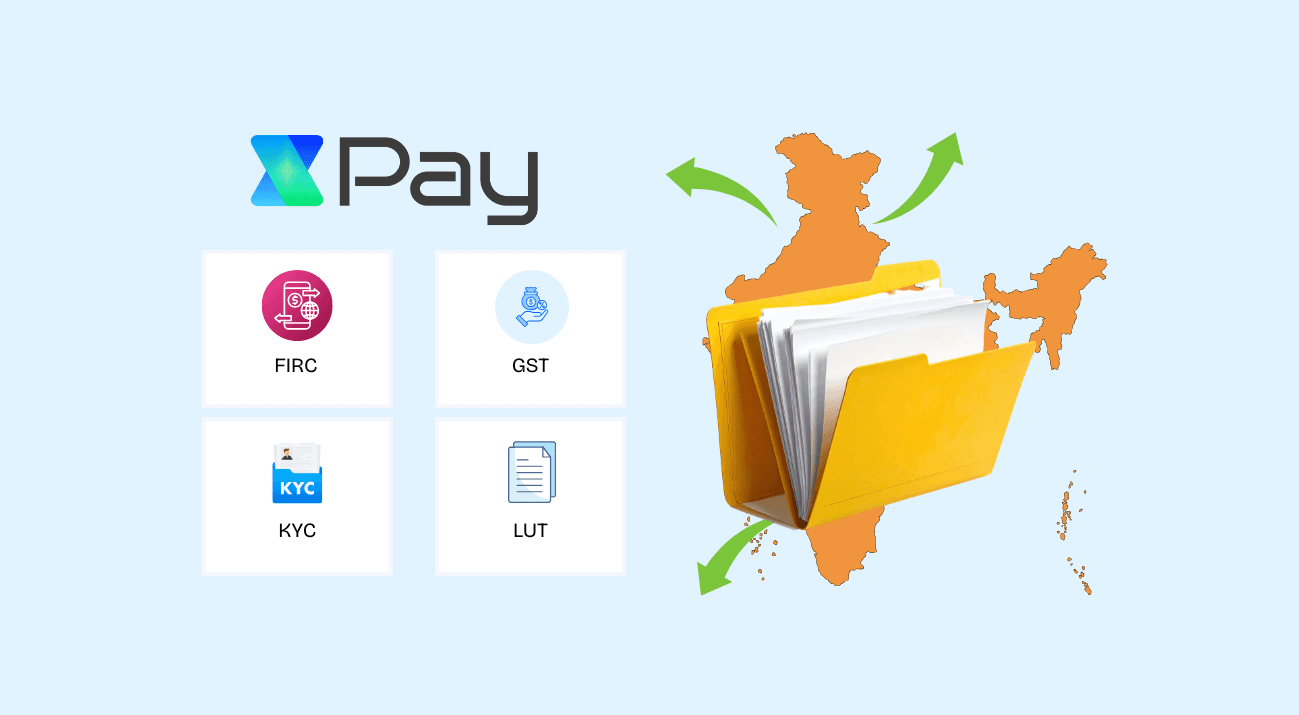
If you are selling globally from India, the core compliance stack usually includes your business registration and tax setup, GST registration, LUT for zero-rated exports, the right inward remittance purpose code, bank-side proof of foreign receipt such as FIRC/e-FIRC/FIRA, KYC/KYB documents, and compliant banking through an AD Category I bank. Whether you need an IEC depends on your model: DGFT says IEC is mandatory for exports in general, but for services exports it is not necessary unless the service provider is taking benefits under the Foreign Trade Policy.
Why do Indian companies need a compliance checklist before selling globally?
Indian SaaS companies need a compliance checklist because cross-border revenue is not just a product or sales problem. It is also a tax, banking, documentation, and FEMA problem, and missing one document can delay settlements, refunds, audits, or export benefit claims.
For most SaaS businesses, the operational pain starts after the sale. The customer pays in foreign currency, but finance teams still need the remittance classified correctly, the tax treatment handled properly, and the bank documentation preserved for GST, audit, and reconciliation.
What documents are required to sell globally from India?
The exact list depends on whether you export goods or services, but for most Indian SaaS exporters, the practical checklist includes GST registration, LUT, the correct purpose code, remittance proof such as FIRC/e-FIRC/FIRA, KYC/KYB documents, and settlement through an authorized banking channel. IEC may also be needed in some cases, especially if you are claiming benefits under the Foreign Trade Policy.
Core document checklist for Indian exporters
Document / Requirement | Why it matters | Who usually asks for it |
|---|---|---|
Certificate of Incorporation / LLP docs | Establishes legal entity | Banks, PSPs, auditors |
PAN of entity | Tax and banking identification | Banks, PSPs |
GST registration | Needed for zero-rated export treatment and LUT filing | GST, auditors, PSPs |
LUT (Form GST RFD-11) | Lets you export services without payment of IGST, subject to eligibility | GST, finance team |
IEC, where applicable | Import-export identifier; DGFT says services exporters may not need it unless taking FTP benefits | DGFT, some banks/partners |
Export invoices | Primary evidence of the service export | Auditors, banks |
Purpose code | Classifies inward remittance correctly | Bank, remittance processor |
FIRC / e-FIRC / FIRA | Proof that foreign funds were received | Auditors, GST, finance |
KYC / KYB set | Verifies business and controllers | Bank, payment partner |
Board resolution / authorized signatory proof | Confirms signing authority | Banks, PSPs |
Customer contracts / MSA / order form | Helps substantiate export of service | Auditors, banks in some cases |
Do SaaS companies need an IEC to export services from India?
Usually, not always. DGFT states that IEC is a key business identification number mandatory for export or import, but specifically says that for services exports, IEC is not necessary except when the service provider is taking benefits under the Foreign Trade Policy.
This is one of the most misunderstood points in Indian export compliance. Many founders assume IEC is always mandatory. In practice, if you are a SaaS company exporting services and not claiming FTP benefits, DGFT’s own guidance says IEC may not be required. But some banks, platforms, and internal finance teams still prefer having it because it reduces ambiguity during onboarding and remittance handling. That is why many SaaS exporters obtain it anyway as a practical compliance convenience, even where it may not be strictly required.
What is IEC?
IEC is the Importer Exporter Code issued through DGFT. DGFT describes it as a key business identification number for exports and imports, and its FAQ notes that issuance is typically immediate after successful application submission.
When should a SaaS company still get an IEC?
A SaaS company should strongly consider getting an IEC if:
your bank asks for it for export operations,
you want a cleaner documentation trail,
you may later claim FTP-linked benefits,
you expect frequent scrutiny from auditors or enterprise customers.
Do you need GST registration to sell software or SaaS globally from India?
Yes, in most practical cases. Exports of goods and services are treated as zero-rated supplies under GST, and exporters generally use GST registration plus LUT to export without payment of IGST and claim input tax credit refunds where eligible.
For a SaaS exporter, GST is not just a tax number. It is the base layer that lets you file LUT, document exports correctly, classify supplies properly, and defend your tax position during audits.
What does zero-rated mean for exports?
Zero-rated means exports are taxable supplies under GST law but can be supplied without payment of IGST under Bond/LUT, or with IGST payment followed by refund, subject to the rules. CBIC’s sectoral FAQ states that exports are treated as zero-rated supplies and exporters can either export under bond/LUT without payment of tax and claim refund of ITC, or pay IGST and claim refund of the tax paid.
What is LUT and why is it important for export of services?
LUT, or Letter of Undertaking, is the standard route most SaaS exporters use to export services without paying IGST upfront. GST guidance says any registered person supplying goods or services for export without payment of integrated tax must furnish LUT in Form GST RFD-11 before making such supplies, subject to eligibility conditions.
Who can file LUT?
CBIC’s consolidated circular says the LUT facility is available to all registered persons intending to export goods or services without payment of integrated tax, except certain persons prosecuted for substantial tax evasion. The GST portal help page similarly states that any registered person availing the option to export without payment of integrated tax has to furnish LUT before export.
How long is LUT valid?
The CBIC circular states that an LUT is valid for the whole financial year in which it is furnished.
Why LUT matters operationally
Without LUT, your tax and working-capital flow becomes more cumbersome. For most SaaS exporters, filing LUT every financial year is one of the simplest and highest-leverage compliance actions.
What purpose code should Indian SaaS exporters use?
Your purpose code is the bank-side classification for the inward remittance, and it should reflect the nature of the export service. In practice, many software and SaaS export flows use P1109, but the correct code depends on the exact nature of the service and how your bank maps the transaction.
This is where many teams get into trouble. They treat purpose code selection as admin work, but it directly affects remittance classification, audit clarity, and how comfortably your AD Category I bank can process and document the inflow.
Why does purpose code matter?
A purpose code matters because banks require it while handling inward remittances, and the supporting forms used by banks explicitly capture purpose code information for export-related receipts.
Is P1109 always the correct code for SaaS?
Not automatically. P1109 is commonly used in software and IT-enabled export discussions, but the right answer depends on what you are actually supplying, how your invoice is worded, and how your bank interprets the service line. The safest operational approach is to align your invoice language, contract language, and remittance purpose code, then confirm the classification with your AD bank or tax advisor before scaling volume.
Practical rule for founders and finance teams
Use one internally approved purpose-code playbook. Do not let sales, finance, and your payment partner all describe the same export differently. Inconsistency is what creates avoidable audit and banking friction.
What is the difference between FIRC, e-FIRC, and FIRA?
All three are used as proof that foreign money was received in India, but they are not always issued in the same format or by the same workflow. In practice, businesses often use the term FIRC broadly, while modern export collections may be documented through digital advice or electronic certificates depending on the bank or remittance partner.
Because terminology varies across banks and platforms, founders should not obsess over the label alone. What matters is whether the document clearly proves foreign inward remittance, links to the transaction, shows the remitter, amount, exchange rate where relevant, and supports your GST and audit trail.
FIRC vs e-FIRC vs FIRA
Term | Typical meaning | Issued by | Practical use |
|---|---|---|---|
FIRC | Foreign Inward Remittance Certificate | Traditionally bank / AD bank | Proof of foreign inward remittance |
e-FIRC / EFIRC | Electronic version of remittance proof | Bank / platform workflow | Faster digital proof for compliance |
FIRA | Foreign Inward Remittance Advice | Often bank / remittance workflow | Advice confirming funds credited |
Third-party explainers and fintech documentation often note that for many export collections today, FIRA or electronic inward-remittance advice is what businesses receive operationally, even though teams may still colloquially call it FIRC.
Which one do auditors and GST teams usually care about?
They usually care less about the label and more about the evidentiary quality. The document should show that the money came from outside India, identify the remitter and beneficiary, support the invoice trail, and be consistent with the purpose code and settlement records.
Important caution
Bank and auditor practice varies. For high-value flows or unusual structures, confirm with your auditor and AD bank what exact remittance proof they will accept for your use case.
What is an AD Category I bank and why does it matter for exports?
An AD Category I bank is a bank authorized by RBI to deal in foreign exchange and handle many export-related transactions under FEMA and RBI directions. In export operations, these banks sit at the center of receipt, classification, documentation, and in many cases the issuance or validation of remittance proof.
For SaaS founders, this is not just a banking detail. Your AD Category I bank is often the institution that determines whether your remittance paperwork is clean or messy.
What does the AD Category I bank do in practice?
AD Category I banks may:
receive inward remittances through normal banking channels,
classify receipts against purpose codes,
maintain exporter documentation,
support EEFC and export-related workflows,
review underlying documents where required under FEMA and RBI rules.
Why this matters for xPay users
If your payment setup eventually needs compliant INR settlement, your structure should tie back cleanly into authorized banking rails. That is what keeps the export story defensible.
What KYC and KYB documents are usually needed to sell globally from India?
KYC and KYB documents are needed because banks and payment partners must verify the business, its controllers, and the legitimacy of the export flow before they can process cross-border collections compliantly. The exact list varies by partner, but entity, tax, ownership, and signatory documents are standard.
Typical KYC / KYB pack for an Indian SaaS exporter
Category | Common documents |
|---|---|
Entity identity | Certificate of Incorporation, PAN, GST certificate |
Address proof | Registered office proof, utility bill, lease if requested |
Ownership | Shareholding pattern, cap table, UBO declaration |
Directors / signatories | PAN, Aadhaar or passport, board resolution, authorization letter |
Business proof | Website, invoices, contracts, product description |
Banking | Cancelled cheque, bank statement, account proof |
Tax and export | LUT, IEC if applicable, purpose-code mapping, sample invoices |
Why payment partners ask for director details
This is normal, not overreach. Cross-border collections trigger AML, sanction-screening, and beneficial-ownership checks, so banks and payment providers often need details of directors, authorized signatories, and ultimate beneficial owners before activation.
What are the FEMA basics every SaaS founder should know?
At a minimum, founders should know that export proceeds must be received through compliant banking channels, documented properly, and classified correctly, with the AD Category I bank playing a central role in handling and evidencing the transaction under RBI/FEMA frameworks.
You do not need to become a FEMA specialist to sell software globally. But you do need a working understanding of a few basics:
FEMA basics for export of services
foreign receipts should come through compliant banking channels,
the nature of the receipt should match the invoice and service supplied,
the purpose code used should fit the transaction,
bank-side records should support repatriation and documentation,
your contracts, invoices, and settlement narrative should not contradict each other.
Where founders usually make mistakes
Mistake | Why it causes issues |
|---|---|
Treating remittance proof as optional | Weak audit trail |
Using inconsistent service descriptions | Bank and tax mismatch |
Ignoring purpose-code discipline | Misclassification risk |
Waiting too late to file LUT | Tax cash-flow friction |
Assuming bank practice is uniform | Different banks ask for different support |
How should SaaS companies structure settlements compliantly?
The cleanest settlement structure is one where customer payment, remittance classification, banking channel, and documentary evidence all align. In other words, the person reviewing your export trail should be able to trace the flow from contract to invoice to inward remittance proof without ambiguity.
A compliant settlement checklist
Clear contract and invoice language
Your service description should match the export you are actually making.Purpose code consistency
The remittance purpose should align with the service category.Authorized banking rails
Settlement should connect cleanly into AD-bank supported channels.Remittance proof retained per transaction or batch logic
Preserve FIRC, e-FIRC, FIRA, or equivalent inward-remittance evidence.Tax position documented
Keep GST registration, LUT, and invoice trail ready for review.
How does xPay help with FIRC / e-FIRC and compliant settlement?
xPay’s value for Indian exporters is not only higher payment performance but also cleaner operational handling of cross-border collections. For businesses using xPay, the goal is to make compliant inward remittance proof and settlement documentation easier to obtain and reconcile, instead of leaving finance teams to manually chase documents after the fact.
How to position the xPay angle in this article
How xPay handles FIRC / e-FIRC automatically: xPay can be positioned as reducing the operational burden around inward-remittance proof by helping merchants receive the remittance evidence they need in a structured, export-friendly workflow.
How settlements are structured compliantly: xPay can be positioned as routing collections and settlements through compliant rails so merchants have a cleaner INR settlement narrative and a more defensible audit trail.
Why this matters in practice
For most SaaS founders, the problem is not knowing that documents exist. The problem is getting all of them to line up at scale. That is where a payments setup should help finance, not create more back-office work.
What is the best document checklist for an Indian SaaS company selling globally?
The best checklist is one that combines tax readiness, bank readiness, and remittance-proof readiness. For most Indian SaaS exporters, that means: entity documents, GST registration, annual LUT, export invoices, purpose-code discipline, remittance proof, KYC/KYB pack, and a compliant settlement flow.
Founder-ready checklist
Entity incorporation documents
PAN of company
GST registration certificate
LUT for the current financial year
IEC, if applicable or operationally preferred
Standard export invoice format
Approved purpose code mapping
FIRC / e-FIRC / FIRA collection process
Bank and AD Category I handling clarity
KYC/KYB pack for PSPs and banks
Contract / MSA / order-form archive
Settlement and reconciliation SOP
Final takeaway
Selling globally from India is not just about enabling card acceptance. It is about building a compliance stack that survives banking review, GST scrutiny, and audit questions.
The good news is that the stack is manageable once you break it down: GST, LUT, purpose code, remittance proof, KYC/KYB, and a clean settlement structure. Get those right early, and global revenue becomes much easier to scale.
FAQ section
Is IEC mandatory for SaaS exports from India?
Not always. DGFT says IEC is generally mandatory for exports and imports, but for services exports it is not necessary unless the service provider is taking benefits under the Foreign Trade Policy.
Do I need LUT for exporting SaaS from India?
If you want to export services without payment of IGST, yes, LUT is the usual route, subject to eligibility. It is filed in Form GST RFD-11 on the GST portal.
What is P1109?
P1109 is commonly used in software and IT-enabled export contexts, but the correct purpose code depends on the exact service and your bank’s classification practice. Confirm the mapping with your AD bank or advisor.
What is the difference between FIRC and FIRA?
Both are used as proof of foreign inward remittance. In practice, many export collections today are documented through advice or electronic formats even though teams may still loosely call everything FIRC.
Which bank handles export remittance compliance?
Typically, your AD Category I bank is central to export remittance handling, documentation, and foreign-exchange compliance under RBI rules.