
Compliance, KYC, AML, and Regulatory Challenges in International Payments

A Technical Guide for Indian Businesses Scaling Globally
As Indian businesses expand into global markets, accepting international payments is no longer just a growth lever. It is a regulatory commitment.
Behind every successful cross-border transaction lies a layered ecosystem of compliance controls, banking oversight, anti-money laundering safeguards, data protection mandates, and central bank regulations. Ignoring or misunderstanding these requirements can result in settlement delays, frozen funds, penalties, or permanent account shutdowns.
This guide breaks down:
How compliance works in international payments
KYC and AML obligations across jurisdictions
Regulatory frameworks affecting Indian exporters
Common risk and compliance pitfalls
How modern payment infrastructure simplifies global compliance
1. Why Compliance Is the Foundation of Cross-Border Payments
Cross-border payments differ fundamentally from domestic transactions because they involve:
Multiple jurisdictions
Multiple regulated entities
Foreign exchange conversion
Cross-border settlement rails
International card network rules
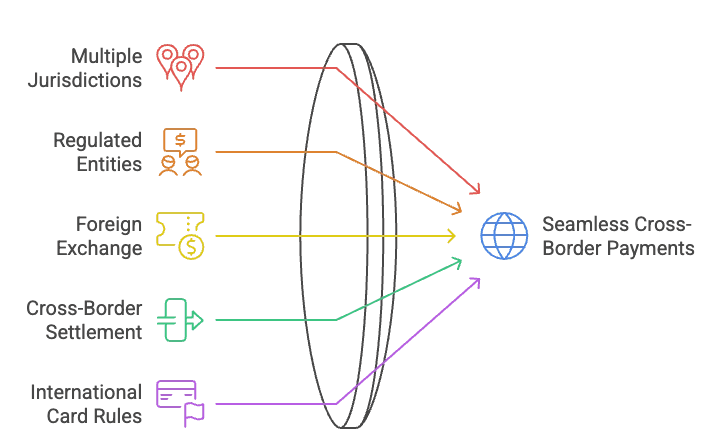
Each layer introduces additional regulatory exposure.
When an Indian merchant accepts a payment from a customer in the US, EU, UAE, or Singapore, the transaction typically touches:
A card network such as Visa or Mastercard
An acquiring bank in the payment processing jurisdiction
A foreign exchange channel
A remittance pathway governed by Indian foreign exchange regulations
Domestic settlement into an Indian bank account
Every participant is regulated. Compliance is not optional. It is infrastructural.
2. Understanding KYC in International Payments
What Is KYC?
Know Your Customer is the regulatory process through which financial institutions verify the identity, legitimacy, and risk profile of a business or individual before enabling financial services.
In cross-border payments, KYC applies to:
Merchants
Beneficial owners
Directors and key management personnel
In some cases, high-risk customers
Why KYC Is Stricter for International Payments
Cross-border transactions carry elevated risks of:
Money laundering
Terror financing
Trade-based fraud
Sanctions violations
Tax evasion
Therefore, acquiring banks and payment providers must conduct enhanced due diligence.
Typical KYC Requirements for Indian Exporters
Certificate of Incorporation
PAN and GST details
Board resolution
Ultimate Beneficial Owner declaration
Bank account verification
Nature of business and website review
Export classification details
In India, payment aggregators and banks operate under the supervision of the Reserve Bank of India.
RBI guidelines mandate strict onboarding and monitoring requirements for payment intermediaries.
Failure to provide complete documentation often leads to onboarding delays or outright rejection.
3. AML and Transaction Monitoring: What Happens After Onboarding
Onboarding is only the beginning.
Anti-Money Laundering compliance continues throughout the merchant lifecycle.
Core AML Components
Sanctions screening against global watchlists
Ongoing transaction monitoring
Suspicious activity reporting
Velocity and behavioral anomaly detection
Chargeback and fraud analysis
Globally, AML standards are shaped by the Financial Action Task Force.
Financial Action Task Force
FATF provides international AML recommendations adopted by over 200 jurisdictions.
Payment providers must implement real-time monitoring systems to:
Detect structuring
Flag unusually large or inconsistent transactions
Monitor high-risk geographies
Identify suspicious refund patterns
If anomalies are detected, accounts may be temporarily suspended pending review.
4. Regulatory Frameworks Governing International Payments
4.1 Indian Regulatory Landscape
Indian exporters receiving international payments must comply with:
FEMA guidelines
RBI Master Directions on export proceeds
Authorized Dealer Category I banking norms
Payment Aggregator cross-border regulations (PA-CB)
Under FEMA, export proceeds generally must be realised within prescribed timelines, subject to sectoral exemptions.
Settlement into India must occur through RBI-regulated channels.
4.2 Global Regulatory Considerations
Depending on where acquiring occurs, merchants may indirectly fall under:
US financial regulations
EU PSD2 standards
UK FCA rules
Singapore MAS guidelines
UAE Central Bank compliance norms
For example:
Financial Conduct Authority regulates payment institutions in the UK.
Monetary Authority of Singapore oversees payment services under the Payment Services Act.
When your payment partner uses licensed foreign entities, compliance obligations extend across these frameworks.
5. Merchant of Record Models and Regulatory Structuring
A Merchant of Record structure centralizes compliance under a regulated foreign entity.
Under this model:
The foreign entity contracts with the end customer
Licensed acquirers process transactions locally
FX conversion occurs at the regulated banking level
Funds are remitted to India through compliant channels
This model is widely used by global platforms such as:
Stripe
dLocal
Properly structured global acquiring reduces:
Cross-border decline rates
Regulatory ambiguity
Settlement unpredictability
Excessive intermediary banking fees
6. Key Compliance Challenges for Indian Businesses
6.1 High Decline Rates Due to Risk Filters
International issuers apply stricter fraud checks for cross-border transactions.
If compliance signals are weak, transactions fail at authorization.
6.2 Chargeback Exposure
Cross-border card transactions carry elevated chargeback risk.
Excessive chargeback ratios can trigger:
Monitoring programs
Increased reserve requirements
Acquirer termination
6.3 Sanctions and Restricted Geographies
Payments involving sanctioned jurisdictions can lead to immediate account suspension.
Providers must screen against OFAC and other global sanctions lists.
6.4 Documentation Gaps
Incomplete export classification, vague business descriptions, or website inconsistencies often lead to compliance escalations.
6.5 Data Protection Requirements
Cross-border payments also intersect with:
PCI DSS standards for card security
Data localization considerations
GDPR exposure when dealing with EU customers
7. Hidden Regulatory Costs in Cross-Border Payments
Compliance impacts cost structures through:
Rolling reserves
Settlement delays
Enhanced due diligence fees
Intermediary bank charges
FX markups
Compliance manpower
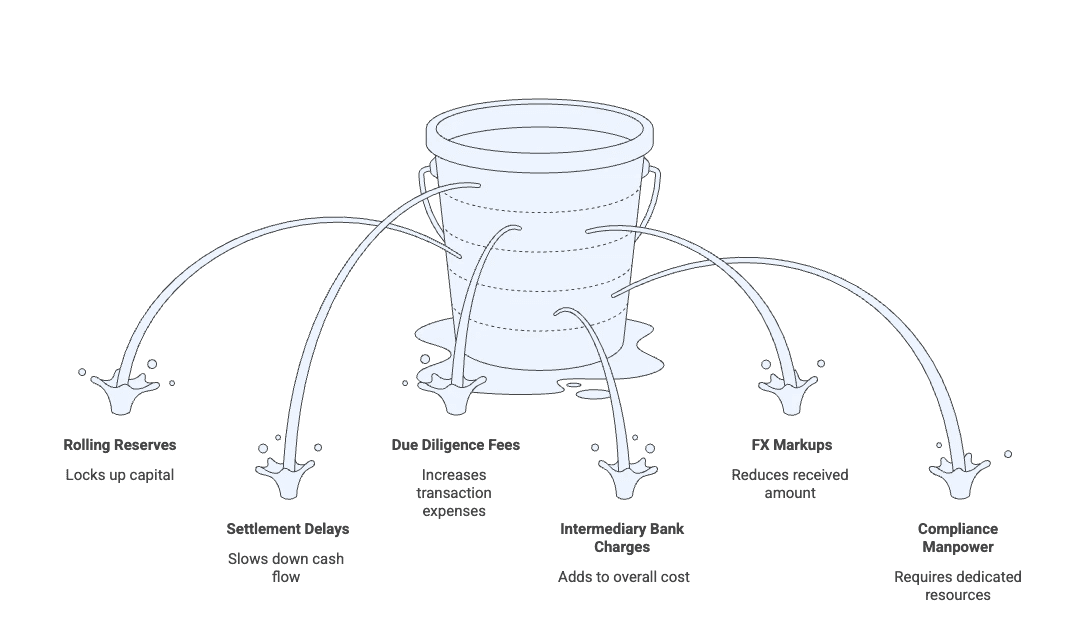
Many merchants only evaluate processing rates but overlook regulatory friction as a cost multiplier.
8. How Modern Infrastructure Reduces Compliance Friction
Advanced cross-border payment platforms integrate:
Automated KYC workflows
Real-time sanctions screening
Smart transaction monitoring
Dynamic 3DS trigger controls
Geo-optimized routing
Multi-currency settlement
For Indian businesses, this translates into:
Faster onboarding
Higher authorization rates
Lower regulatory exposure
Compliant INR remittance
9. Best Practices for Managing International Payment Compliance
Maintain updated corporate documentation
Clearly describe business models and refund policies
Implement transparent checkout disclosures
Monitor chargeback ratios monthly
Avoid high-risk geographies without regulatory clarity
Partner with globally licensed processors
Ensure PCI DSS compliance for card handling
Maintain export reconciliation records
Compliance is an operational discipline, not a one-time checklist.
10. The Future of Cross-Border Compliance
Regulators worldwide are increasing scrutiny on:
Digital services exports
Subscription-based global businesses
BNPL cross-border flows
Crypto-linked transactions
Real-time transaction monitoring and AI-driven compliance engines are becoming standard infrastructure.
Businesses that embed compliance into product architecture scale faster and face fewer disruptions.
FAQs
What is the difference between KYC and AML?
KYC focuses on verifying identity and legitimacy at onboarding. AML involves ongoing monitoring to detect suspicious activity.
Why are cross-border transactions more heavily monitored?
They carry higher risk of money laundering, sanctions violations, and fraud due to jurisdictional complexity.
Can funds be frozen during compliance review?
Yes. If transactions trigger AML alerts or sanctions screening issues, temporary restrictions may apply.
Do Indian businesses need to comply with foreign regulations?
Indirectly, yes. If payments are processed via foreign acquiring entities, those entities must comply with their local regulators.
How can merchants reduce compliance-related declines?
Improve checkout transparency
Enable 3DS intelligently
Maintain low chargeback ratios
Use geo-optimized acquiring
Keep documentation current
What happens if chargeback ratios exceed thresholds?
Card networks may place merchants in monitoring programs, leading to higher fees or termination risk.